Michigan is a no-fault divorce state. A divorce complaint is based on the breakdown of the marriage relationship, rather than proving a spouse committed wrongdoing. Michigan Compiled Laws § 552.6 sets out that standard.
Before a Michigan court grants a divorce, one spouse generally must have lived in the state for 180 days and in the filing county for 10 days immediately before filing; the statute contains a narrow exception to the county requirement. Michigan Compiled Laws § 552.9 explains those residency rules. A divorce can still involve difficult decisions about children, support, property, and debt, whether it is contested or uncontested.
Understanding Divorce in Michigan
Michigan is a no-fault divorce state, meaning no proof of wrongdoing is needed to end a marriage. You only need to show that the relationship is irreparable. Despite this, divorces require significant decisions about child custody, spousal support, child support, and property division, all of which need careful consideration under Michigan law.
To file for divorce in Michigan, one spouse must have lived in the state for at least 180 days and in the filing county, such as Wayne County, Oakland County, or Macomb County, for at least 10 days before filing. Once these requirements are met, the case moves forward through the court system, often involving document preparation, financial disclosure, and negotiation before a judge can finalize the dissolution.
The Divorce Process in Dearborn
The divorce process begins when one spouse files a complaint with the Wayne County Circuit Court. After filing, the other spouse must be formally notified, typically through certified mail or a process server. This notification gives them time to respond, usually within 21 days. If no response is filed, the court may enter a default judgment, finalizing the divorce without additional participation from the other spouse.
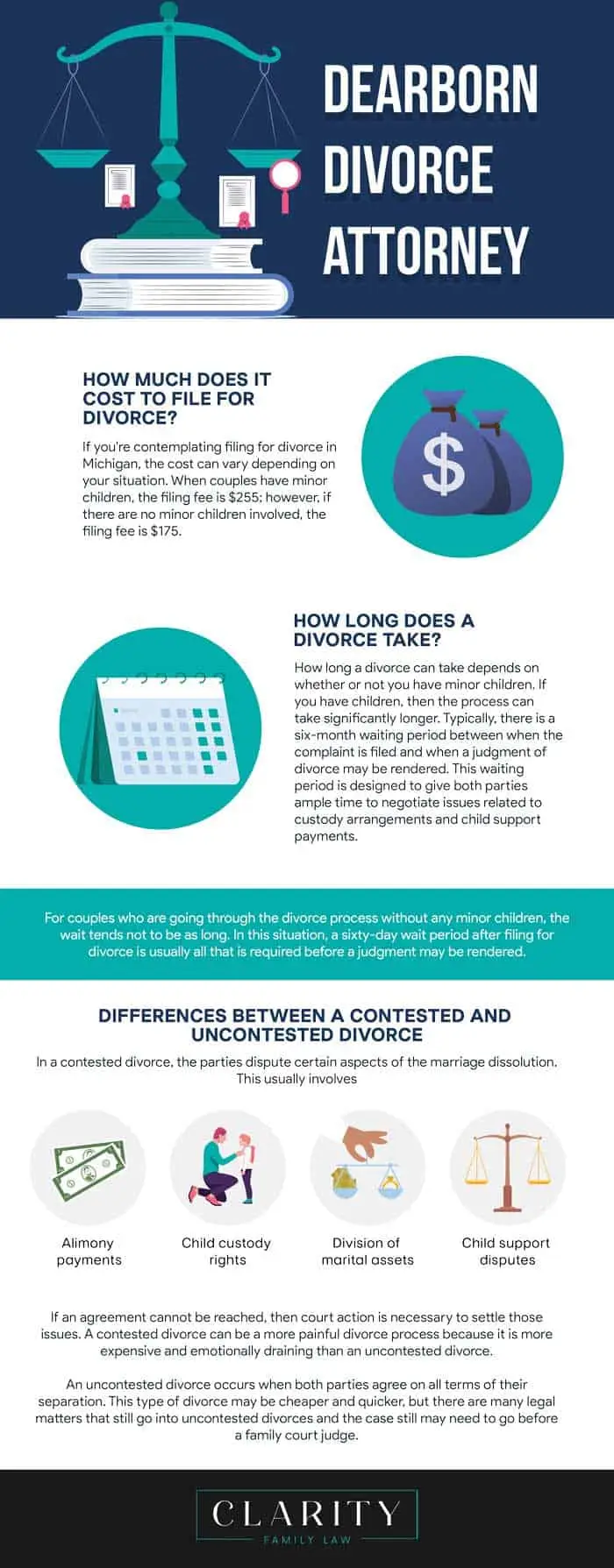
When both parties are involved, if they agree on key issues, they may pursue an uncontested divorce. If not, they face a contested divorce, each with distinct requirements, timelines, and challenges.
Uncontested Divorce
An uncontested divorce is often straightforward and efficient. If both spouses agree on asset division, parenting time, and support, the process is quicker, cheaper, and less stressful. It’s crucial to ensure compliance with Michigan laws by preparing a marital settlement agreement, verifying financial disclosures, and obtaining signed affidavits of consent.
Even in amicable separations, guidance from a knowledgeable divorce lawyer can help prevent errors and future disputes. The attorney ensures that the court filings are accurate and that agreements are enforceable, helping both spouses move forward on solid legal ground.
Learn more about Uncontested vs. Contested Divorce in Michigan
Contested Divorce
A contested divorce occurs when spouses disagree about key issues such as custody, support, or asset distribution. These cases can become complex and emotionally charged, requiring court hearings, evidence submission, and negotiation between attorneys. Common disputes involve child custody, spousal support, and the division of community assets.
In high-asset divorces, issues such as business ownership, real estate, and investments often come into play. Disputes may also arise when there are claims of domestic violence or sexual abuse, both of which can impact custody and protective orders. Contested cases often take several months to resolve, but with strategic representation and strong legal counsel, it’s possible to reach fair resolutions that protect a client’s interests.

Collaborative Divorce and Mediation
For many couples, litigation isn’t the only option. A collaborative divorce allows both spouses to work together outside of court, each represented by their own attorney. The focus is on open communication, mutual respect, and creative problem-solving. The benefits of mediation are that it can significantly reduce conflict and help both parties maintain control over the outcome.
In Wayne County, mediation is another valuable tool for resolving disputes related to child custody, parenting time, or spousal support. A trained neutral mediator facilitates discussion to help both sides reach an agreement without the need for a trial. This approach encourages cooperation, reduces costs, and often results in outcomes that feel fair and balanced for everyone involved.
Key Issues in a Michigan Divorce
Every divorce has unique dynamics, but several core issues commonly arise during the process. These matters often determine how the divorce will progress and what outcomes each party can expect.

Child Custody and Parenting Time
When children are involved, decisions about custody, visitation, and parenting time become central to the case. Michigan courts always prioritize the best interests of the child, considering factors such as emotional stability, parental involvement, home environment, and each parent’s ability to provide care. Arrangements may include joint custody or sole custody, depending on the circumstances.
Skilled family lawyers ensure fair parenting plans by establishing custody orders, modifying them, and advocating in court when disputes can’t be mediated.
Learn More: Who Gets Custody During an Ongoing Divorce?
Child Support
Child support ensures that children’s needs continue to be met following divorce. Michigan uses the Michigan Child Support Formula, which factors in each parent’s income, the number of children, health care costs, and parenting time. These payments are designed to cover essentials such as housing, education, and medical care.
Enforcing or modifying a child support order requires attention to detail and a clear understanding of the guideline formulas. Effective legal support helps parents understand their obligations, file accurate financial information, and ensure compliance with court mandates.
Spousal Support
Financial fairness is another key component of divorce. Spousal support, sometimes called alimony, may be awarded to help a lower-earning spouse maintain stability after separation. The court considers factors such as each party’s earning capacity, standard of living, and the length of the marriage.
Legal guidance ensures that requests for spousal support are supported by evidence and handled in a way that reflects each party’s financial situation. For many couples, fair spousal support arrangements help both individuals move forward confidently after divorce.
Property Division
Michigan follows the principle of equitable distribution, meaning marital property is divided fairly, though not always equally. This includes income, real estate, retirement accounts, vehicles, and shared investments. The court also considers debt settlement, the length of the marriage, and contributions made by each spouse, financial and otherwise.
Complex divorces with business or high-value assets require accurate valuation and documentation. Strategic attorneys ensure transparency, protect property rights, and achieve fair resolutions reflecting contributions.
Learn More: What is a Property Settlement Agreement?
The Importance of Legal Support
Divorce is not simply a legal formality; it’s a major life transition that affects families, finances, and future plans. Reliable legal guidance ensures every step of the process is handled correctly, reducing stress and preventing costly mistakes. From drafting petitions to representing clients in court hearings, a qualified divorce lawyer provides the structure and advocacy needed to achieve fair outcomes.
Clarity Law Firm emphasizes open communication and personalized representation. They help clients overcome language barriers, financial stress, and emotional strain, offering tailored legal support for each unique case.
Beyond Divorce: Related Family Law Matters
Divorce often intersects with other family-law questions, including paternity, parenting time, support, and protective orders. Addressing the issues that apply to a particular family early can make the court process easier to understand.

How Long Does a Divorce Take in Michigan?
The timeline for finalizing a divorce in Michigan varies based on family circumstances and court availability. Under Michigan Compiled Laws § 552.9f, testimony generally cannot be taken until 60 days after filing, and cases involving dependent minor children generally have a six-month waiting period, subject to statutory exceptions.
Contested divorces can be lengthy due to discovery, negotiations, and temporary orders. Clear communication with your attorney helps manage expectations and reduce stress.
Resolving Conflict and Protecting Families
Although divorce can create emotional strain, it doesn’t have to result in ongoing hostility. Through divorce mitigation, collaboration, and compassionate representation, many couples can minimize confrontation and focus on the future. Attorneys at Clarity Law Firm emphasize solutions that protect families, preserve relationships where possible, and promote lasting stability.
Contact a Dearborn Divorce Attorney Today
When faced with the uncertainty of divorce, having trusted legal counsel by your side makes all the difference. Whether the case involves property disputes, child custody arrangements, or financial disagreements, a Dearborn divorce attorney from Clarity Law Firm can provide the knowledge and strategy needed to protect your rights.
Serving Dearborn, Wayne County, Oakland County, and Macomb County, Clarity Law Firm takes a client-first approach that prioritizes transparency, communication, and compassion. Schedule a confidential consultation today at (313) 513-1919 to receive the personalized legal support necessary to move forward confidently.
Frequently Asked Questions About Divorce in Dearborn
Even with careful preparation, divorce often brings many questions. Below are answers to some of the most common concerns individuals face when considering or going through a divorce in Michigan.
Michigan is a no-fault divorce state, requiring no proof of wrongdoing. You must show that the marriage is irreparably broken. However, misconduct like domestic violence can affect custody, support, and property division decisions.
Michigan follows equitable distribution, dividing property and debts fairly, not always equally. Courts evaluate income, marriage length, asset contributions, and financial needs. Complex cases, like those with business or high assets, may need financial experts and a divorce attorney for fair valuation and outcomes.
In Michigan, child custody prioritizes the child’s best interests, awarding joint or sole custody based on parental cooperation, parent-child relationships, and home stability. Parenting time and visitation are detailed in court orders to meet the child’s emotional and physical needs. Mediation or a family law attorney can assist parents in custody disputes.
Yes. Couples can opt for collaborative divorce or mediation, negotiating with attorneys or mediators to resolve issues and minimize costs and stress. Unresolved disputes will be decided by a judge in Michigan courts.